
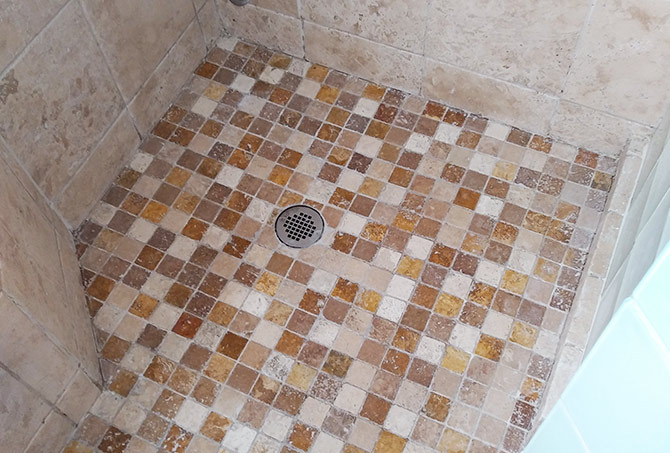
Travertine Shower Sanitized and Restored
Calcium buildup, grime, and deteriorated caulk were addressed before the travertine shower was professionally cleaned, sanitized, sealed, and restored.
Now Hiring! Contact us for more information!
Paradise Valley properties often feature natural stone in floors, bathrooms, showers, patios, pool areas, fountains, and other indoor and outdoor spaces. Travertine brings warmth and character to these surfaces, but its porous nature and unique characteristics require the right care to maintain its appearance.
Beyond Stone Solutions provides professional travertine cleaning, sealing, honing, and polishing for properties in Paradise Valley, Arizona. Whether your travertine needs a thorough cleaning, protection against staining, restoration of a worn finish, or a combination of treatments, we evaluate the stone first and recommend an approach based on its condition and the result you want.
From ongoing maintenance to more involved restoration, our goal is to help you maintain the beauty and performance of your existing travertine.
For 50 years, Beyond Stone Solutions has helped Arizona homeowners and businesses clean, restore, and protect natural stone. From routine travertine care to complex restoration, our experienced team brings specialized stone-care knowledge to every project.
Travertine can remain beautiful for many years with proper care, but everyday use can gradually change its appearance. Foot traffic, spills, dirt, moisture, cleaning products, and outdoor exposure can all affect the stone over time.
A travertine floor may become dull or scratched. A shower can develop soap film or mineral buildup. An outdoor surface may accumulate dirt or lose its original finish. A previously polished surface may become worn and lose its reflectivity.
Sometimes professional cleaning and sealing are all the stone needs. In other situations, the surface itself needs to be restored through honing or polishing.
The first step is understanding what is actually happening to the stone.
Professional cleaning can help when dirt, oils, soap film, embedded soil, or other buildup has accumulated on the surface or within the natural texture of the travertine.
Routine sweeping and mopping may not remove deeply embedded soil, particularly on textured or heavily used surfaces.
Professional cleaning may be appropriate for:
Natural stone should be cleaned with appropriate stone-safe products and methods. Harsh acidic or abrasive household cleaners can damage travertine and may create additional restoration needs.
Travertine is porous, so liquids can penetrate the stone and potentially contribute to staining.
An appropriate impregnating sealer can help reduce absorption and give you more time to clean up spills before they penetrate the stone. Sealing does not make travertine completely stain-proof, and it does not eliminate the need for routine care, but it can be an important part of a natural stone maintenance plan.
Sealing may be appropriate after:
The appropriate sealer depends on the stone, finish, location, and intended use. Interior and exterior travertine may require different approaches.
Cleaning cannot correct every travertine problem.
If the stone is clean but still looks dull, scratched, etched, worn, or uneven, the problem may involve the surface finish rather than the cleanliness of the stone.
Honing uses abrasive diamond tooling to refine the stone’s surface and address scratches, etching, and other surface imperfections. It can create a smooth, softer, low-reflectivity finish.
Polishing uses progressively finer abrasives to increase reflectivity and create a more refined finish.
Depending on the condition of the stone and the desired appearance, travertine can be restored to a natural honed finish, a polished finish, or another appropriate level of refinement.
Beyond Stone Solutions has completed documented travertine cleaning, honing, polishing, refinishing, and sealing projects in Arizona.
Our case studies show how professional stone restoration can address different surface conditions and applications, from worn travertine floors to exterior stone that needs refinishing.
Calcium buildup, grime, and deteriorated caulk were addressed before the travertine shower was professionally cleaned, sanitized, sealed, and restored.
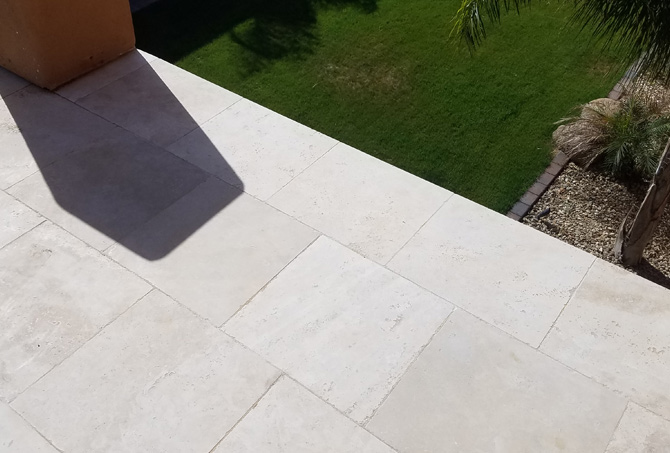
We removed rust stains caused by an exterior railing and lightly polished this exterior travertine. Looks great again!
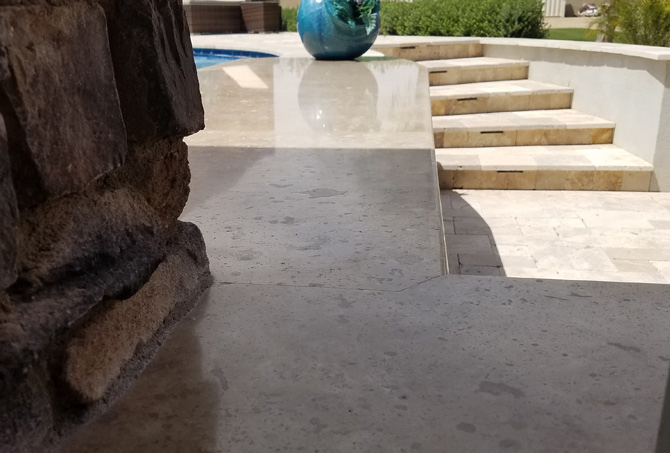
We changed the finish of these exterior travertine tops from a dull, honed finish to a lightly polished finish.
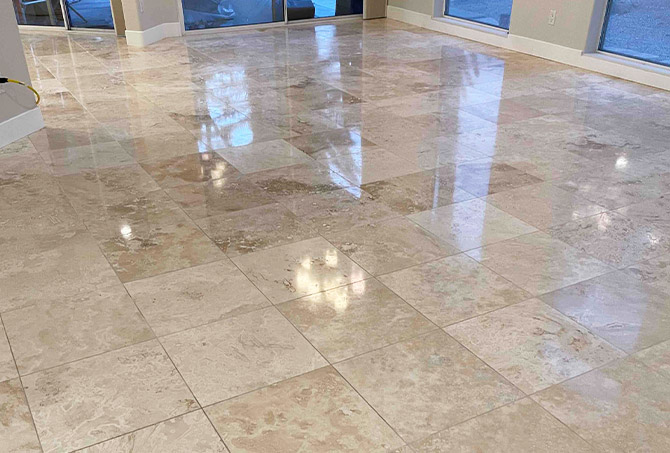
We refinished and sealed this travertine floor, erasing signs of wear and restoring the reflection.
These services are not necessarily separate treatments.
A travertine restoration project may require several steps to achieve the desired result.
For example, a worn floor may first need professional cleaning to remove embedded soil. If scratches or surface wear remain, honing may be necessary. If a higher-reflectivity finish is desired, polishing can follow. Once the surface has been restored, an appropriate sealer may be applied to help inhibit staining.
The process should be determined by the condition of the stone, rather than by a predetermined package.
That’s why Beyond Stone Solutions evaluates the surface before recommending a restoration approach.
Travertine floors can gradually develop traffic patterns, scratches, dull areas, and accumulated soil, particularly in busy entryways, kitchens, living areas, and other high-use spaces.
A floor that looks permanently dirty may not actually need a stronger cleaning product. It may need professional restoration.
Beyond Stone Solutions can evaluate whether the floor would benefit from deep cleaning, honing, polishing, sealing, or a combination of treatments.
When the underlying stone is still sound, professional restoration may improve the appearance of existing travertine without requiring complete replacement.
Travertine is a popular choice for showers and bathrooms because of its natural appearance and distinctive variation.
However, wet environments create their own maintenance challenges.
Soap film, hard-water deposits, staining, and moisture can affect both the appearance and condition of the stone. Improper household cleaners can also etch or dull travertine over time.
Professional cleaning can remove buildup that routine maintenance cannot, while appropriate restoration and sealing can help keep the surface easier to maintain.
If your shower still looks cloudy, stained, or worn after cleaning, the problem may require more than another round of household cleaner.
Outdoor travertine requires a different maintenance strategy from interior stone.
Patios, pool areas, walkways, fountains, and other exterior surfaces are exposed to sunlight, dust, moisture, weather, and everyday outdoor use.
Over time, outdoor travertine can become dull, dirty, discolored, or affected by previous coatings and treatments.
Beyond Stone Solutions can evaluate exterior travertine and determine whether the surface needs cleaning, coating removal, honing, polishing, or an appropriate penetrating or enhancing sealer.
A worn travertine surface does not automatically mean the stone needs to be removed and replaced.
When the underlying stone is structurally sound, professional restoration may address surface wear, dullness, staining, etching, or finish problems and significantly improve the appearance of the existing installation.
Restoration may be appropriate when travertine has:
A professional evaluation can help determine whether restoration is a practical alternative to replacement.
There is no universal travertine treatment that works for every property.
Our process begins by understanding what is happening to the stone.
Depending on the project, we may:
Not every project requires every step. The goal is to perform the work the stone actually needs.
Natural stone restoration is different from ordinary cleaning.
Travertine has its own characteristics, finishes, porosity, and maintenance requirements. A cleaning or restoration method that is appropriate for one surface may be inappropriate for another.
Beyond Stone Solutions has specialized in natural stone care in Arizona since 1976. Our work includes cleaning, stain treatment, honing, polishing, sealing, repair, and restoration for a wide range of natural stone surfaces.
That experience matters when the goal is not simply to make a surface look cleaner temporarily, but to restore the stone properly and establish an appropriate care approach for the future.
Professional restoration is only part of keeping travertine looking its best.
After restoration, everyday care can make a significant difference.
For routine maintenance:
Regular maintenance can help preserve the appearance of the restored surface and may reduce the need for more extensive restoration later.
If your travertine needs more than cleaning and sealing, Beyond Stone Solutions offers additional specialized services.
Whether your travertine needs professional cleaning, sealing, finish restoration, honing, polishing, or a combination of services, Beyond Stone Solutions can evaluate the stone and recommend the appropriate next step.
Request a Free Estimate to discuss your Paradise Valley travertine with a natural stone specialist.
Call Today at (602) 830-5861