Now Hiring! Contact us for more information!
Now Hiring! Contact us for more information!
When Scottsdale travertine begins to look dull, scratched, cloudy, worn, or uneven, routine cleaning may no longer be enough. Professional honing and polishing can restore the stone’s surface and bring back the finish you want—whether that means a soft, natural honed appearance or a highly reflective polished finish.
Beyond Stone Solutions has been restoring natural stone throughout Arizona since 1976. Our travertine restoration process is tailored to the condition of the stone, the type of surface damage, and the finish you want to achieve. We work with travertine floors, showers, countertops, patios, pool areas, fountains, and other residential and commercial surfaces throughout Scottsdale.
Need to restore dull or damaged travertine? Contact Beyond Stone Solutions for a professional evaluation and free estimate.
For 50 years, Beyond Stone Solutions has helped Arizona homeowners and businesses restore, refine, and protect natural stone surfaces. Our experienced team brings specialized stone-care knowledge to everything from everyday travertine maintenance to complex restoration.
Travertine has a naturally distinctive appearance, but years of foot traffic, cleaning, spills, scratches, old coatings, and everyday use can gradually change the way the surface looks and feels.
A floor may still be clean but appear dull. A previously polished surface may lose its reflection in high-traffic areas. Fine scratches can make the stone look dirty even after it has been thoroughly cleaned. An old topical coating can become cloudy, worn, or damaged and may need to be removed before the stone can be properly refinished.
That’s where professional honing and polishing can make a meaningful difference.
Honing and polishing are finish-restoration processes, not simply more aggressive forms of cleaning. They are appropriate when the stone’s surface itself has become worn or damaged.
You may benefit from professional travertine honing or polishing if you notice:
The right treatment depends on what is actually happening to the surface. In some cases, cleaning and sealing may be sufficient. In others, the stone needs mechanical honing and polishing to correct surface damage and restore the finish.
Understanding the difference can help you determine what your travertine needs.
Honing uses abrasive diamond tooling to refine the surface and remove a very thin layer of stone. It can help eliminate fine scratches, surface wear, etching, and other imperfections while creating a smooth, low-reflectivity finish.
Polishing takes the process further by using progressively finer abrasives to increase the stone’s reflectivity and create a smoother, more refined appearance.
The desired result does not have to be extremely glossy. Depending on the stone and your preference, the finish can range from a soft, natural honed appearance to a highly reflective polished surface.
Beyond Stone Solutions has documented multiple Scottsdale travertine restoration projects involving honing, polishing, refinishing, and sealing.
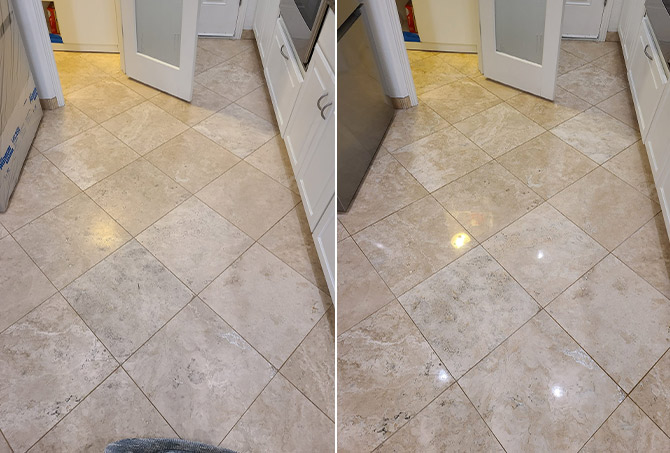
One Scottsdale homeowner contacted us after a travertine floor had lost its reflection and developed a dirty-looking appearance despite regular sweeping and mopping. We honed the floor to address fine scratches and surface damage, then used progressively finer diamond pads to achieve a reflective polished finish before applying an impregnating sealer.
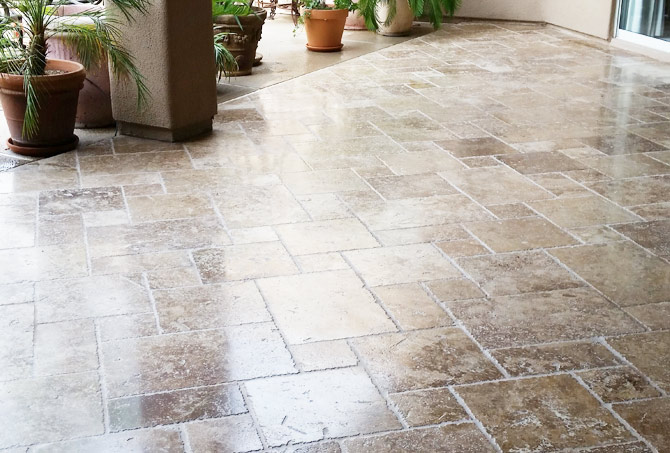
Exterior travertine can present a different set of challenges. In one Scottsdale patio project, a topical sealer had failed after exposure to Arizona's intense sun. The existing coating was stripped, the travertine was honed and polished, and a penetrating enhancing sealer was applied to achieve a natural polished appearance without relying on another topical coating.
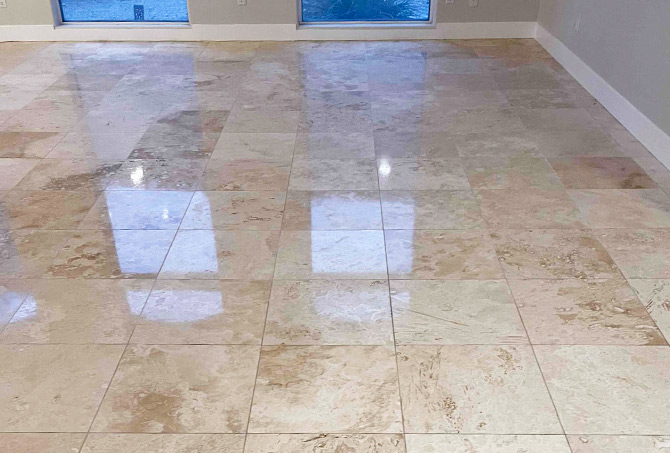
In another Scottsdale home, travertine flooring had an existing coating along with dullness, etching, and light scratches in high-traffic areas. The coating was removed, the stone was honed to eliminate the surface damage, and progressively finer diamond pads were used to restore the desired level of polish.
There is no single “best” travertine finish for every Scottsdale property.
A polished finish can create a bright, elegant appearance and emphasize the natural movement and variation in the stone. A honed finish provides a softer, more understated look and may be preferred when a highly reflective surface is not appropriate for the space.
The location matters, too.
A travertine floor in a formal interior may have different finish requirements than a busy entryway, shower, patio, fountain, or outdoor living area. Exterior stone also has to contend with Arizona’s intense sun and outdoor conditions.
Beyond Stone Solutions evaluates the existing surface before recommending a restoration approach rather than assuming every travertine installation should receive the same finish.
Every project is different, but professional travertine polishing and honing generally begins with evaluating the existing stone and identifying the source and extent of the surface damage.
Depending on the condition of the travertine, the process may include:
1. Surface evaluation
We assess the finish, surface wear, scratches, etching, coatings, staining, and other conditions that may affect the restoration.
2. Preparation and protection
The surrounding area is protected before restoration begins. For interior projects, this can include protecting cabinets, baseboards, appliances, walls, and other nearby surfaces.
3. Removal of problematic coatings when necessary
If an old topical coating is failing or interfering with the desired finish, it may need to be removed before the travertine can be properly restored.
4. Honing
Diamond abrasives are used to refine the stone and address surface damage. The appropriate level of honing depends on the condition of the travertine and the finish being pursued.
5. Progressive polishing
When a polished finish is desired, progressively finer diamond abrasives are used to increase reflectivity and refine the appearance of the surface.
6. Cleaning and final treatment
Once the desired finish has been achieved, the surface is cleaned and, when appropriate, treated with a suitable penetrating sealer to help inhibit staining.
The goal is not simply to make the travertine shiny. The goal is to create a finish that looks appropriate for the stone, the property, and the way the surface is used.
Travertine polishing and honing can be appropriate for many different surfaces, including:
Interior and exterior surfaces should not automatically be treated the same way. Exterior travertine, for example, is exposed to sunlight, weather, moisture, and other environmental conditions that can affect coatings and surface treatments.
For that reason, we consider the location and use of the stone when determining the appropriate restoration process.
A polished finish can dramatically change the appearance of travertine, but restoration is about more than creating shine.
Professional honing can remove a thin layer of damaged stone and help eliminate the fine scratches and surface wear that make travertine appear dull or dirty. Progressive polishing can then refine the surface and increase its reflectivity.
The result can be a cleaner-looking, more consistent surface that better reflects the character of the original stone.
And when the restoration is followed by an appropriate maintenance and protection plan, it can also make it easier to keep the surface looking its best.
There is no universal schedule for travertine polishing or honing.
The right maintenance interval depends on factors such as:
Some surfaces may only need periodic cleaning and maintenance, while heavily used areas may eventually benefit from light honing, repolishing, and resealing.
The goal is to address wear before the stone becomes severely damaged or requires a more extensive restoration.
Travertine is a natural stone, and its surface can respond differently depending on its composition, finish, previous treatments, and condition.
Using the wrong abrasive, chemical, coating, or restoration method can create additional problems rather than solving the original one.
Beyond Stone Solutions approaches travertine restoration by evaluating the existing surface first and selecting a process based on the actual condition of the stone. Our team has been working with natural stone in Arizona since 1976, giving homeowners and property professionals a long history of specialized surface-care experience.
Honing refines the stone’s surface and generally produces a smooth, low-reflectivity finish. Polishing uses progressively finer abrasives to increase reflectivity and create a more polished appearance. A restoration project may use honing first and polishing afterward.
Fine surface scratches can often be addressed through professional honing and refinishing. Deeper damage may require a different restoration approach. An evaluation is the best way to determine what can be corrected and how extensive the work needs to be.
Yes. Exterior travertine can be professionally honed and polished, but outdoor stone requires consideration of Arizona’s intense sun, weather exposure, moisture, and previous coatings. Beyond Stone Solutions has completed Scottsdale exterior travertine restoration involving coating removal, honing, polishing, and penetrating enhancement.
Looking for help with a different travertine concern? Explore these related services from Beyond Stone Solutions:
Your travertine does not necessarily need to be replaced just because it has lost its original appearance.
If the surface is dull, scratched, worn, or simply no longer looks the way you want it to, professional honing and polishing may be able to restore its appearance and extend the life of the stone.
Beyond Stone Solutions serves Scottsdale and surrounding Arizona communities with specialized natural stone restoration services. Request a free estimate to discuss your travertine and determine the right restoration approach for your property.
Call Today at (602) 830-5861